
The American Birds of Dorothy Doughty
Ongoing
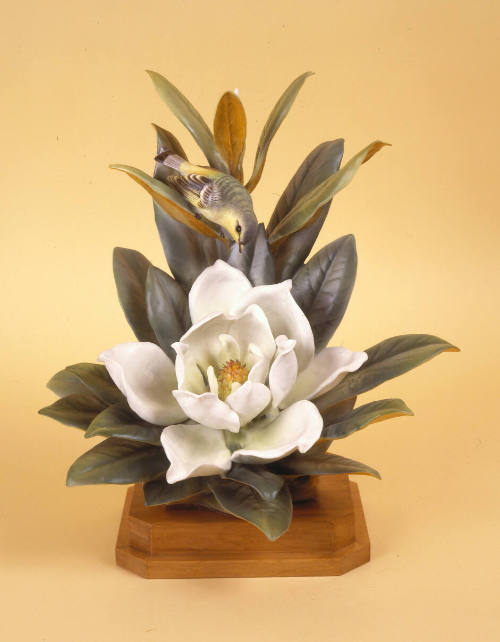
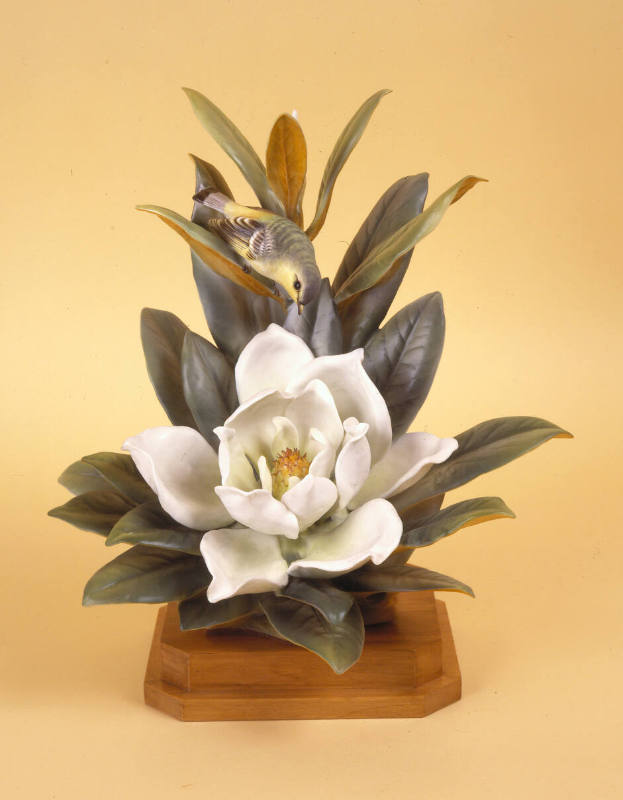
The collection of American Birds by Dorothy Doughty consists of sculptures in porcelain which capture a living bird perched dramatically on a spray of natural vegetation. They spring from the hands of Dorothy Doughty and are the product of a unique teamwork between the modeler and the craftsmen of the Royal Worcester factory in Worcester, England.
Dorothy Doughty was born in San Remo, Italy, in 1892, the daughter of General Charles Doughty, a distinguished writer and traveler, the author of Arabia Deserta. Her mother was an enthusiastic watercolorist and encouraged Dorothy to study at the Eastbourne School of Art and elsewhere. In the 1930s Miss Doughty lived in the charming village of Sissinghurst in Kent and as a keen naturalist had soon learned to love birds. Miss Doughty agreed to model a series of birds for Royal Worcester.
Although she had some guidance from her sister, Freda, Dorothy Doughty had not been trained as a porcelain modeler and at first had little understanding of the problems of firing ceramics. She learned how to model the birds in plasticine, so that Worcester craftsmen could cut them up into small parts from which plaster molds were made. From the molds were cast the small pieces in raw clay which were fitted together and fired in the kilns, the clay shrinking by a great amount during this firing.
Miss Doughty’s first models were somewhat stiff, partly due to her inexperience as a modeler, but mainly because the factory lacked the courage to attempt too much freedom of movement. The American Redstarts and Hemlock, her first model, produced in 1935, are firmly supported by both wings on the sprays of hemlock which are cast from liquid clay in a mold. The Redstarts were a first cautious step.
The Baltimore Orioles and Tulip Tree and Chickadees and Larch, both issued in 1938, show that most of the initial problems in techniques had been conquered and the birds had been given amazing freedom. The wings of the Chickadees are both free flying. Miss Doughty overcame the problems of unsupported parts, sagging in the kiln by using removable props of similar clay which were placed underneath the more fragile parts just prior to firing, and which were removed after the group was taken out of the kiln.
World War II, which started in 1939, made a big difference in Miss Doughty’s life. She drove an ambulance during the Plymouth bombings, assisted in experimental aircraft manufacture, and gave therapeutic training to injured soldiers, teaching them to make flower groups which are exhibited in the Stark Museum as Alpine Flower Rocks.
The Mexican Feijoa and Ladybirds in 1950, and Red-Eyed Vireos and Swamp Azalea in 1952 showed the flower modeling at its best. The most immediate problem was the shortage of live American birds to use as models. Miss Doughty strove to use closely related British species, but finally she was sent to the United States by Royal Worcester in 1953, visiting southern and eastern states.
In 1956 Miss Doughty made her second trip to the United States, visiting the desert areas of Texas, Arizona and New Mexico-and this produced what are probably her greatest pieces. The Elf Owl and Saguaro, was a striking single model, unique in that it was intended to depict moonlight falling on Saguaro cactus with the tiny bird returning to its nest, and it is regarded by many as Miss Doughty’s finest model. Also the result of this trip, the Phoebes and Flame Vine, modeled in 1958, showed the birds on a wild flower of Tennessee, and the Cactus Wrens and Prickly Pear of 1959 captured perfectly the bird life of the desert.
Henry Sandon
Curator
Worchester Royal Porcelain Company and The Dyson Perrins Museum, Worcester, England
Dorothy Doughty was born in San Remo, Italy, in 1892, the daughter of General Charles Doughty, a distinguished writer and traveler, the author of Arabia Deserta. Her mother was an enthusiastic watercolorist and encouraged Dorothy to study at the Eastbourne School of Art and elsewhere. In the 1930s Miss Doughty lived in the charming village of Sissinghurst in Kent and as a keen naturalist had soon learned to love birds. Miss Doughty agreed to model a series of birds for Royal Worcester.
Although she had some guidance from her sister, Freda, Dorothy Doughty had not been trained as a porcelain modeler and at first had little understanding of the problems of firing ceramics. She learned how to model the birds in plasticine, so that Worcester craftsmen could cut them up into small parts from which plaster molds were made. From the molds were cast the small pieces in raw clay which were fitted together and fired in the kilns, the clay shrinking by a great amount during this firing.
Miss Doughty’s first models were somewhat stiff, partly due to her inexperience as a modeler, but mainly because the factory lacked the courage to attempt too much freedom of movement. The American Redstarts and Hemlock, her first model, produced in 1935, are firmly supported by both wings on the sprays of hemlock which are cast from liquid clay in a mold. The Redstarts were a first cautious step.
The Baltimore Orioles and Tulip Tree and Chickadees and Larch, both issued in 1938, show that most of the initial problems in techniques had been conquered and the birds had been given amazing freedom. The wings of the Chickadees are both free flying. Miss Doughty overcame the problems of unsupported parts, sagging in the kiln by using removable props of similar clay which were placed underneath the more fragile parts just prior to firing, and which were removed after the group was taken out of the kiln.
World War II, which started in 1939, made a big difference in Miss Doughty’s life. She drove an ambulance during the Plymouth bombings, assisted in experimental aircraft manufacture, and gave therapeutic training to injured soldiers, teaching them to make flower groups which are exhibited in the Stark Museum as Alpine Flower Rocks.
The Mexican Feijoa and Ladybirds in 1950, and Red-Eyed Vireos and Swamp Azalea in 1952 showed the flower modeling at its best. The most immediate problem was the shortage of live American birds to use as models. Miss Doughty strove to use closely related British species, but finally she was sent to the United States by Royal Worcester in 1953, visiting southern and eastern states.
In 1956 Miss Doughty made her second trip to the United States, visiting the desert areas of Texas, Arizona and New Mexico-and this produced what are probably her greatest pieces. The Elf Owl and Saguaro, was a striking single model, unique in that it was intended to depict moonlight falling on Saguaro cactus with the tiny bird returning to its nest, and it is regarded by many as Miss Doughty’s finest model. Also the result of this trip, the Phoebes and Flame Vine, modeled in 1958, showed the birds on a wild flower of Tennessee, and the Cactus Wrens and Prickly Pear of 1959 captured perfectly the bird life of the desert.
Henry Sandon
Curator
Worchester Royal Porcelain Company and The Dyson Perrins Museum, Worcester, England