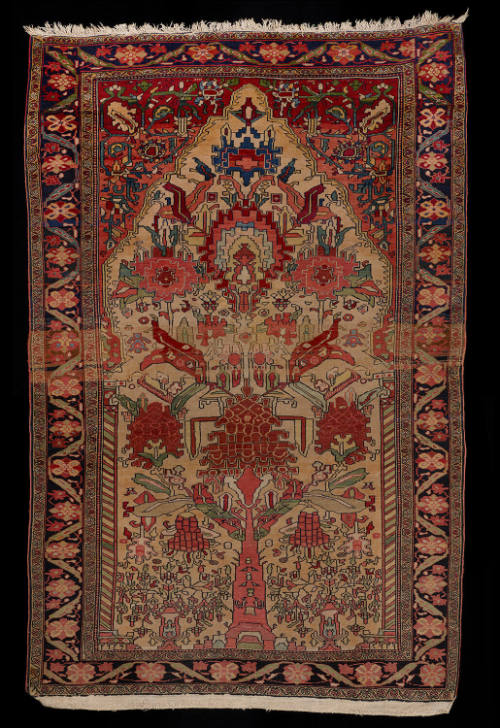
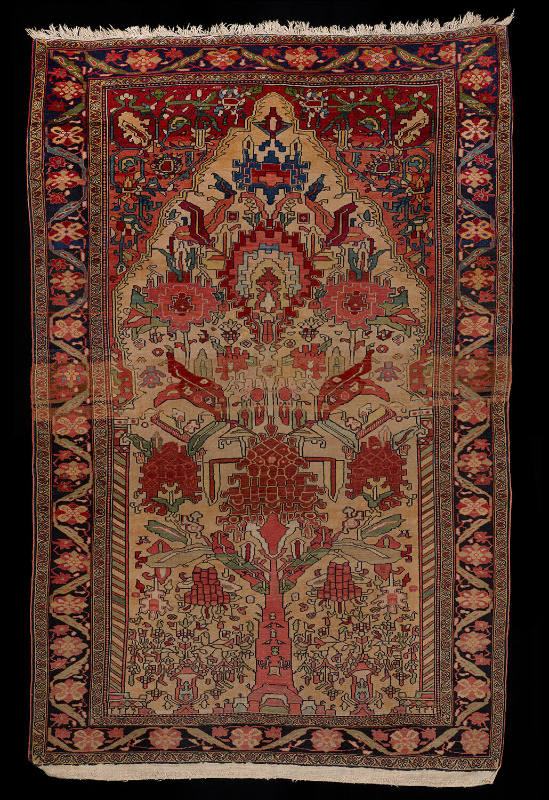
Sarouk
Persian
In the second half of the 19th century, a huge market was created for Persian carpets in Europe and in the US. Many merchants bought the old and antique Persian rugs from all over Iran and exported them to other countries. They used the city of Tabriz in northwest Iran to export these antiques to Europe via Arzerum in Turkey. Some merchants also used the southern ports on the Persian Gulf to export Persian rugs to the US by ship. By the later decades of the 19th century, around 1880, the supply of these fine antique rugs from Persia was on the low side. Therefore, many of the merchants from Tabriz decided to establish workshops in Sultanabad to produce rugs based on the western demand. This region had a fine carpet weaving tradition and was a perfect place to set up looms and rug workshops. Sarouk, is a village located 30 miles north of the city of Sultanabad (today called Arak). To meet the rising demand in the west for Persian rugs, the British-Switzerland company of Ziegler & Company opened its office in Tabriz in 1878 and in Sultanabad in 1883.
Sarouk rugs have been produced for much of the twentieth century. From the 1910s to 1950s, the “American Sarouk” also known as the “Painted Sarouk” was produced. American customers had an affinity for the Sarouk’s curvilinear and floral designs. What they did not appreciate, however, was the color, so for much of the 1920s, 30s and 40s, rugs exported from Iran would get a dye job to a desirable, deep, raspberry-red color, once they made it to the States.
Sarouk rugs continue to be produced today, using the same methods as during early production – with the exception of the post-production dye job. Known for their exceptional quality and ability to withstand decades of wear, Sarouks continue to be a best seller of the Persian rugs. They are made with a high quality, tough wool using a Persian knot. A tell tale sign of a Sarouk is usually its blue weft threads, salmon or tomato-red color mixed with ivory and blues, and a very traditional, floral style. The finest of the modern Sarouk rugs comes from the small town of Ghiassabad.
Person TypeRegion
English, founded 1680